/appstore.png)
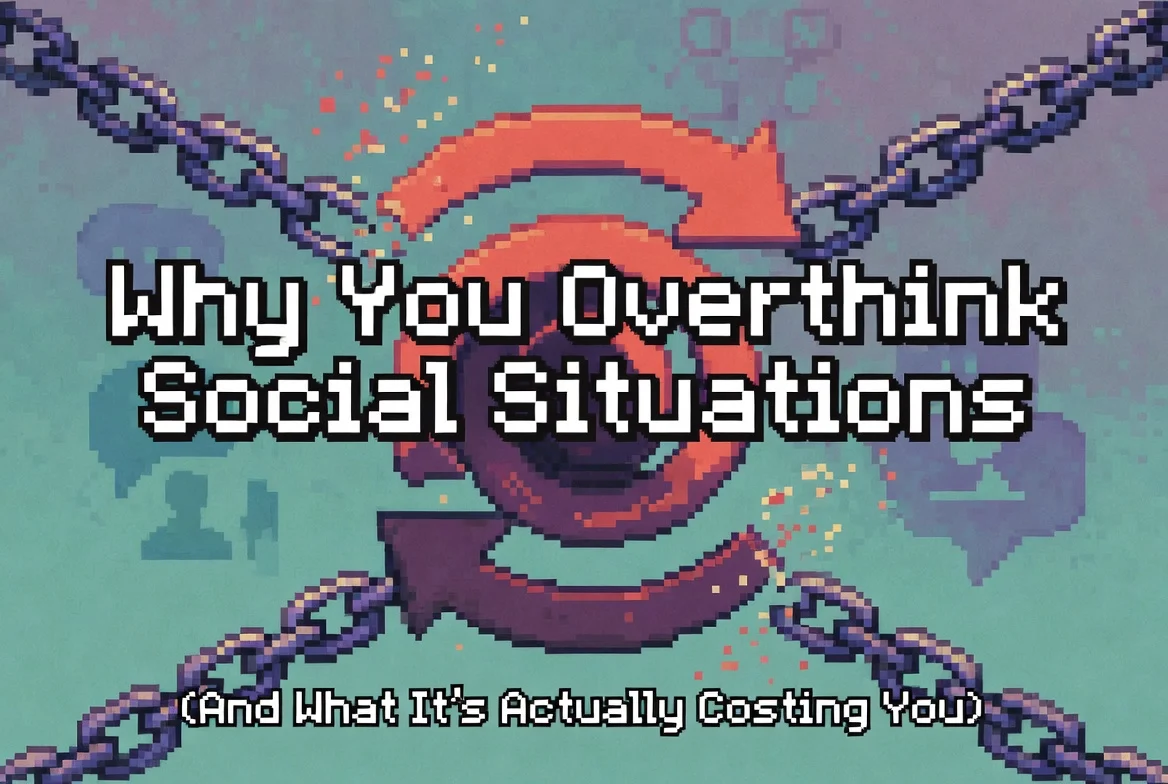
Why You Overthink Social Situations (And What It's Actually Costing You)
The replay after a conversation isn't just annoying — it's avoidance in disguise. Here's what helps, plus three practices to interrupt it.
You know the thing where a conversation ends, and then you spend the next two hours still in it?
You replay the part where you stumbled over your words. You decide that the pause before they answered meant something. You land on the worst possible version of how it went, promise yourself you’ll do better next time — and then, quietly, start looking for reasons to skip the next thing entirely.
That last part is the bit most articles miss.
The overthinking isn’t just exhausting. It’s doing a job. Every time you replay a conversation and conclude it went badly, you’re adding another data point to the case against trying. The gap between where you are and where you want to be socially doesn’t stay the same size. It grows — one avoided situation at a time, one two-hour replay at a time.
This article is about what’s actually happening when you do this, and three things you can practice to interrupt it. Not to fix you. Just to make the gap a little smaller.
Cherry is a practice tool, not a replacement for therapy. If social anxiety is significantly affecting your daily life, a mental health professional is the right starting point.
TL;DR
- Post-event replay is often post-event processing—a mental habit that protects you from trying again by “proving” the interaction went badly.
- It feels like analysis; functionally it can be avoidance with extra steps.
- Interrupting it takes new data from small real-world reps, not only arguing with the thoughts.
Quick answers
Why can’t I stop replaying conversations?
Your brain is trying to reduce uncertainty and prevent future threat—but the replay usually widens the gap between you and the next interaction.
Is overthinking the same as problem-solving?
Problem-solving ends with a next action. Overthinking loops without new evidence—often reinforcing the same conclusion.
What helps besides “think positive”?
Time-box the replay, write one factual sentence about what happened, and schedule one small approach behaviour for next time.
Why the replay happens at all
Here’s what research on social anxiety actually shows — and what it means for you.
When you’re in a social situation and you’re anxious, your attention doesn’t stay on the conversation. Part of it turns inward. It starts monitoring: how do I sound, what does my face look like, are they noticing that I’m nervous. It’s running a background check on you, in real time, while you’re trying to talk to someone. 1
What that means practically: you’re not fully present for the interaction. You’re watching yourself have it. And what gets recorded in memory isn’t what actually happened — it’s the running commentary. The anxiety. The self-monitoring. Not the conversation itself.
So when you replay it later, you’re not reviewing evidence. You’re reviewing the feeling of being anxious. Which is why the conclusions are always the same: it went badly, they noticed, you should have done better.
Researchers who study social anxiety call this post-event processing. They’ve found it’s not just a symptom of anxiety — it’s one of the main things that keeps it going. 2 The replay doesn’t help you prepare for next time. It just makes next time feel more threatening.
Which brings us back to avoidance. The replay is avoidance continuing after the event ended. Your brain didn’t stop protecting you when you left — it just switched methods.
The three versions of this (one of them is probably yours)
The replaying doesn’t always look the same. It shows up in three different places, and it’s worth knowing which one you’re dealing with.
After the fact. The situation is over but you’re still in it. You’re going over what you said, what they said, what your face did. You’re reading meaning into things that probably had none. This is the most common version, and the most studied. 2
Before the event. You replay a situation before it’s even happened. You run through every way it could go wrong. By the time you get there — if you get there — you’ve been anxious about it for hours. This one doesn’t just affect how you feel. It affects how you show up, which then feeds back into the after-the-fact version.
During the event. Part of your attention is watching you have the conversation instead of having it. This is the root of the whole thing. 1 It’s why you leave interactions feeling like you performed worse than you did, because you were partially absent for them. And it’s exhausting in a way that’s hard to explain to people who don’t experience it.
Most people with social anxiety cycle through all three. But usually one of them is doing the most damage. The after-the-fact replay tends to be where people lose the most hours. The pre-event version tends to be where avoidance starts.
What the research says — and what it actually means
There’s a well-known model for how social anxiety works, developed by two researchers in 1995, that maps this loop precisely. 3 The short version: self-focused attention during social situations is what keeps the whole thing running. You monitor yourself, which interferes with your actual performance, which gives you worse material to review afterward, which makes the next situation feel more threatening.
Here’s what that actually means for you: the problem isn’t that you’re bad at social situations. It’s that you’re doing two things at once — participating and observing — and that split is what makes it hard.
The research on what helps is consistent. Studies on reducing post-event replaying found that labelling what’s happening — naming it as a pattern rather than a verdict — is one of the more effective first moves. 4 And studies on attention show that redirecting focus outward during interactions, toward the other person rather than yourself, reduces anxiety and actually improves how you come across. 1
Not because of mindset. Because of mechanics.
Three things you can practice
These aren’t fixes. They’re reps. The point isn’t to do them once and feel better — it’s to do them repeatedly until they become the default response instead of the spiral.
1. Name the loop when it starts.
When you notice the replay beginning, say it plainly — out loud or in your head: I’m replaying this conversation. Then ask one question: what did I actually observe, something they said or did, versus what I felt?
That question creates a small gap. You’re not stopping the thought. You’re just separating what happened from your interpretation of what happened. That gap is where you have room to move. 4
2. Practice pointing your attention outward.
This one takes repetition in low-stakes situations before it transfers to harder ones. Start somewhere that doesn’t matter much — a brief exchange, a short interaction you don’t have a stake in. The practice is just: pick one external thing to follow. What is this person actually saying? What do they seem interested in?
You’re not trying to be calm or present or switched on. You’re practicing redirecting once. The goal isn’t a perfect interaction. The goal is one rep of noticing that you went inward, and bringing your attention back out. 1
3. Interrupt the spiral before it runs its full course.
Research on what happens right after an anxious interaction found that even brief distraction — something that requires your attention — reduces how bad you feel about the situation compared to letting the replay run. 5 You don’t need to resolve it. You just need to shorten the uncontrolled part.
A version you can use:
- Name it: I’m replaying [the situation].
- Ask: what did I actually observe — not feel — that suggests something went wrong?
- Switch to something that needs your hands or your eyes for a few minutes.
- If you want to think it through properly, set a deliberate time for it. Outside that window, come back to step 3.
This isn’t about willpower. It’s about shortening the loop — one time at a time.
The thing nobody says about this
Most content about overthinking treats it like a thinking problem. Like if you just thought about it differently, or thought about it less, you’d be fine.
But for people with social anxiety, the replay is downstream of avoidance. The less you practice being in social situations, the more each one feels like a test. The more it feels like a test, the more your brain monitors during it. The more it monitors, the worse the material it has to review. The worse the review, the stronger the case for avoiding the next one.
The gap doesn’t stay the same. It grows.
Which means the replay isn’t really the problem to solve. It’s a signal. It’s your brain telling you that the stakes feel too high — because you haven’t had enough low-stakes reps to know that most situations aren’t that serious.
The three practices above don’t fix the loop by thinking your way out of it. They’re ways to take one rep at a time. Name it once. Redirect once. Shorten the spiral once. And do it again next time.
That’s how the gap gets smaller. Not by crossing it in one go.
Common questions
Is overthinking a symptom of social anxiety? It’s more than a symptom — it’s one of the main things that keeps social anxiety going. Replaying social situations negatively has been consistently linked to social anxiety staying in place across multiple studies. 2 It’s not a character flaw. It’s a pattern that developed for a reason and can be changed with practice.
How long does it take to see a difference? There’s no reliable single answer, and we’re not going to give you one. Studies show consistent practice has measurable effects over weeks, but the range across people is wide. The goal of these techniques isn’t to produce a timeline. It’s to shorten individual spirals — one at a time.
Can I practice these without a therapist? The techniques here come from self-guided CBT research, including studies on app and web-based tools tested in controlled trials. 6 Self-guided practice has shown real effects for everyday social anxiety. For clinical-level social anxiety disorder, working with a therapist is the better starting point — and these techniques can sit alongside that work.
What if I try these and nothing changes? That’s worth paying attention to. These work for a lot of people. They’re not universal. If you’ve practiced consistently and nothing is shifting, that’s a useful signal — and worth discussing with a professional.
One more thing
If you’ve read this far, you probably recognised something in it. The bus ride where you replayed one sentence the whole way home. The way you decided to stay quieter next time. The way “next time” keeps getting postponed.
You’re not broken. You’re under-practised. And the gap between where you are and where you want to be is made of avoided reps — which means it can be made smaller the same way it got bigger. One situation at a time.
That’s what Cherry is built for.
Sources
All sources are peer-reviewed and publicly accessible via PubMed or PMC.
[1] Spurr & Stopa (2002) — Self-focused attention in social phobia and social anxiety — PubMed
[2] Brozovich & Heimberg (2008) — An analysis of post-event processing in social anxiety disorder — PubMed
[3] Clark & Wells (1995), reviewed in PMC — A cognitive model of social phobia
[4] Cassin & Rector (2014) — Cognitive restructuring and mindfulness on post-event processing — PubMed
[5] Kocovski et al. (2013) — Distraction and post-event processing in social anxiety — PubMed
[6] Rees et al. (2018) — Web-based social anxiety intervention — randomised controlled trial — PubMed
Cherry is a self-guided practice tool. It is not therapy and does not provide clinical diagnosis or treatment. If you’re in crisis, please contact a licensed mental health professional or your local emergency services.
Related Articles
Social anxiety vs shyness: how to tell the difference
Shyness vs social anxiety: how they differ in daily life, introversion clarified, when to seek a therapist, and small exposure-style steps to try.
Why does my heart race in social situations?
Why your heart races in social situations: fight-or-flight, how self-focused attention worsens it, and breathing, grounding, and exposure tactics.
Physical symptoms of social anxiety: what your body is doing and why
Why social anxiety causes a racing heart, blushing, shaking, and nausea—and simple breathing, grounding, and first-step tactics you can try.