/appstore.png)
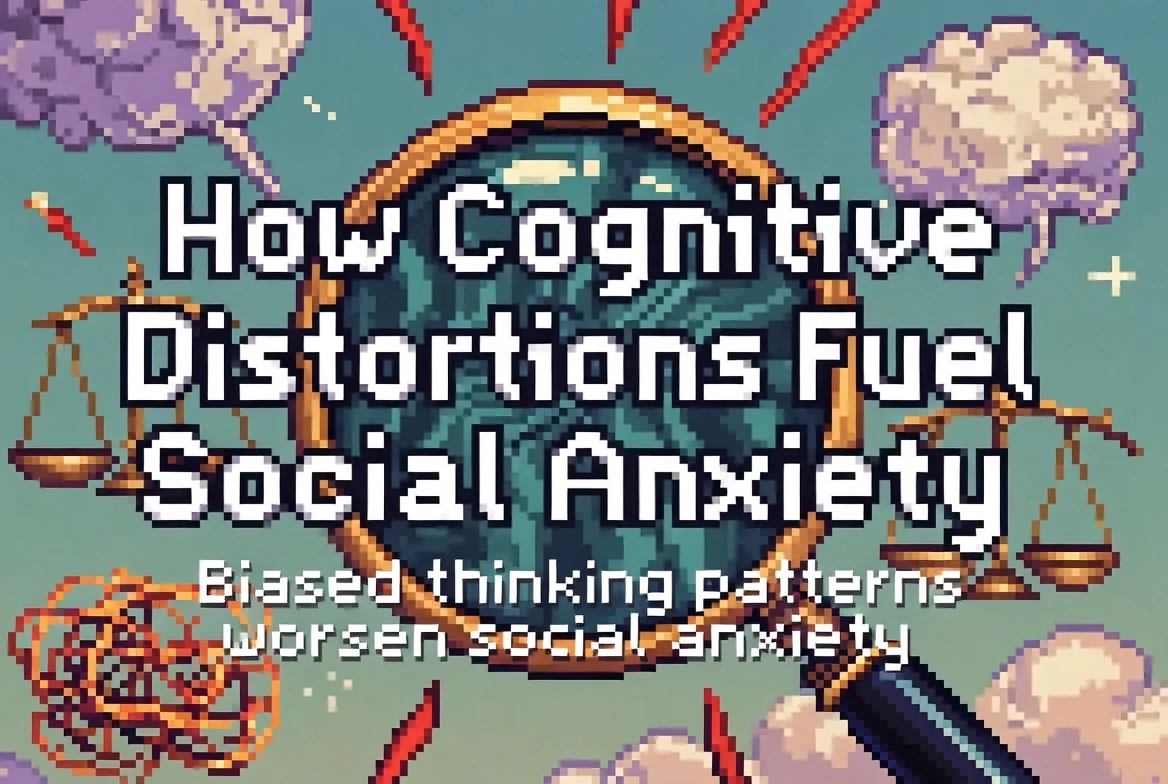
How Cognitive Distortions Fuel Social Anxiety
Biased thinking patterns worsen social anxiety. How interpretation bias ties to symptoms—and practical ways to spot and soften distortions.
Cognitive distortions are biased ways of interpreting what happened—or what might happen—that make social situations feel more dangerous than the facts support. In social anxiety they often show up as mind-reading (“they think I’m boring”), catastrophising (“I’ll embarrass myself”), or overgeneralising (“I always mess up”).
Research on interpretation bias—tending to read ambiguous social cues as negative—finds a robust association with social anxiety across dozens of studies; reviewers describe this bias as a plausible maintenance factor worth targeting in treatment. 1 Classic cognitive models of social anxiety also emphasise self-focused attention and negative self-imagery that skew what gets noticed and remembered in the first place. 2 3
Recognising the pattern doesn’t magically erase anxiety. But it does move you from “the world is objectively hostile” to “my brain is running a fast, negative filter”—which is where cognitive restructuring and behavioural experiments gain traction.
Cherry is a practice tool, not a replacement for therapy. If social anxiety is significantly affecting your daily life, a mental health professional is the right starting point.
TL;DR
- Cognitive distortions are fast, biased interpretations—not neutral facts about what others think.
- In social anxiety, interpretation bias (reading ambiguous cues as negative) tracks closely with symptoms.
- Naming the pattern is the start; behavioural experiments and exposure are how beliefs actually update.
Quick answers
What is a cognitive distortion?
A habitual thinking shortcut that makes situations feel more dangerous or hopeless than the evidence supports.
Does noticing thoughts fix social anxiety?
Not by itself. It creates room to test thoughts with small real-world steps instead of treating every worry as true.
Which distortions show up most around people?
Mind reading, catastrophising, and all-or-nothing standards are especially common—see the table below.
Common distortions in social anxiety
| Pattern | What it sounds like | Why it costs you |
|---|---|---|
| Mind reading | “They noticed I was awkward.” | You treat a guess as a fact. |
| Catastrophising | “If I pause, it’ll be unbearable.” | Small friction becomes proof of disaster. |
| All-or-nothing | “I stumbled once—ruined.” | Flawless performance is set as the standard. |
| Emotional reasoning | “I feel judged, so I am judged.” | Feelings replace evidence. |
| Should statements | “I should never be nervous.” | Anxiety becomes moral failure. |
These labels come from everyday CBT language; what matters clinically is that they predictably narrow your options—usually toward avoidance or freezing.
Meta-analytic work ties self-reported interpretation bias especially closely to social anxiety severity, more so than some objective task formats—so how you describe situations to yourself is part of what maintains the loop. 1
What helps: question the thought without debating all night
1. Name the distortion — “That was mind-reading” or “that’s catastrophising.” Naming turns a verdict into a category.
2. Ask for observables — What did someone actually say or do? What would a neutral third party list as evidence?
3. Generate one alternative — not a forced-positive affirmation, just a plausible neutral read (“they might have been tired”).
4. Run a small behavioural test — one question, one minute longer, one reply—so belief updates come from behaviour, not rumination.
Studies in analogue samples suggest cognitive restructuring exercises can shift how people perform under scrutiny in controlled tasks, though single-session lab formats don’t always generalise everywhere researchers measure—so expect practice in real contexts, not one-and-done relief. 4 At the treatment level, cognitive-behavioural packages—including cognitive work—remain among the best-supported psychological approaches for social anxiety disorder in large comparative reviews. 5
Common questions
Are cognitive distortions “the cause” of social anxiety? They’re one maintenance pathway. Models also highlight attention, imagery, safety behaviours, and post-event replay—not only thoughts. 2 3
Is cognitive restructuring enough on its own? Sometimes partially; many evidence-based protocols combine cognitive work with exposure-style behavioural practice. 5
What if I believe the negative thought? Start with impact: “Even if part of this were true, do I want it to decide whether I speak or stay?” Behavioural tests still collect useful data.
Sources
[1] Chen J, Short M, Kemps E. — Interpretation bias in social anxiety: A systematic review and meta-analysis — PubMed
[2] Spurr JM, Stopa L. — Self-focused attention in social phobia and social anxiety — PubMed (review discussing Clark & Wells 1995 cognitive model)
[3] Heinrichs N, Hofmann SG. — Information processing in social phobia: a critical review — PubMed
[4] Nowakowski ME, Antony MM, Koerner N. — Modifying interpretation biases: Effects on symptomatology, behavior, and physiological reactivity in social anxiety — PubMed
[5] Mayo-Wilson E, et al. — Psychological and pharmacological interventions for social anxiety disorder in adults: a systematic review and network meta-analysis — PubMed
Cherry is a self-guided practice tool. It is not therapy and does not provide clinical diagnosis or treatment.
Related Articles
Social anxiety vs shyness: how to tell the difference
Shyness vs social anxiety: how they differ in daily life, introversion clarified, when to seek a therapist, and small exposure-style steps to try.
Why does my heart race in social situations?
Why your heart races in social situations: fight-or-flight, how self-focused attention worsens it, and breathing, grounding, and exposure tactics.
Physical symptoms of social anxiety: what your body is doing and why
Why social anxiety causes a racing heart, blushing, shaking, and nausea—and simple breathing, grounding, and first-step tactics you can try.