/appstore.png)
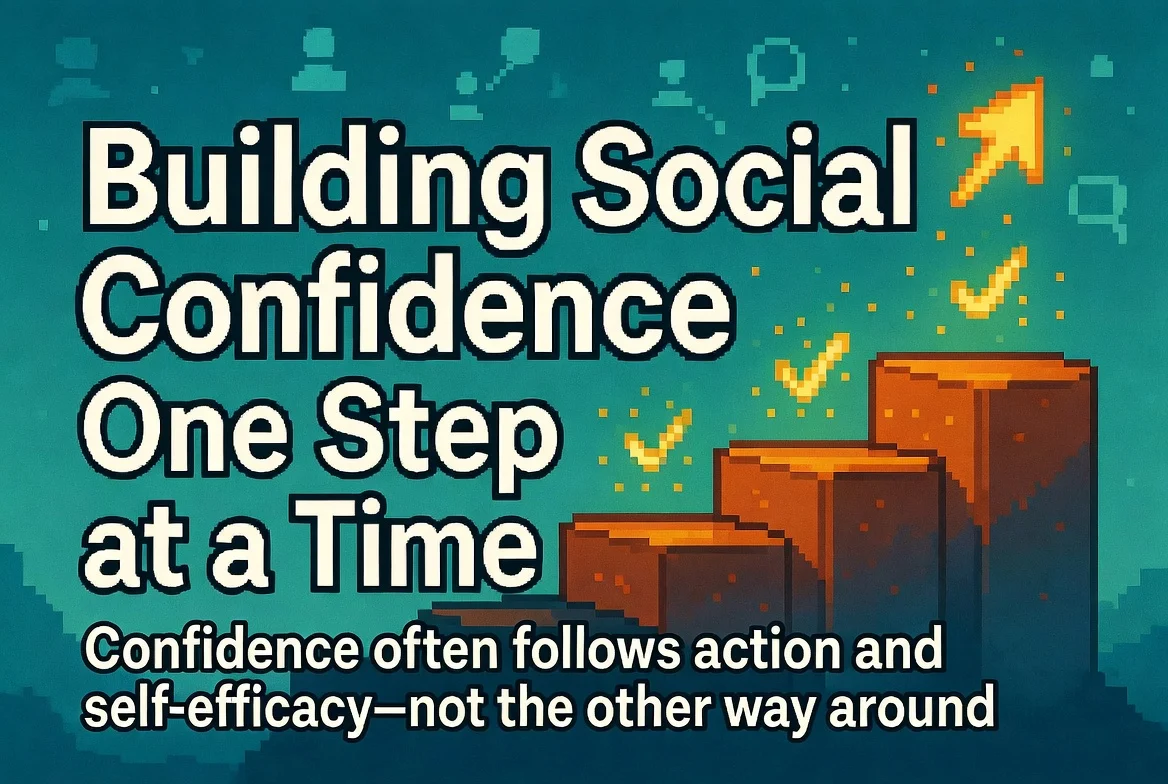
Building Social Confidence One Step at a Time
Confidence often follows action and self-efficacy—not the other way around. What studies of social anxiety suggest, and small steps that add up.
Many people wait to feel confident before doing the things they avoid. In real life, the sequence is often reversed: you take a small risk, discover you can survive it, and your sense of what you can handle inches upward. Psychologists call part of that self-efficacy—beliefs about your ability to manage challenging situations.
That isn’t motivational poster logic. In treatment research for social anxiety disorder, changes in self-efficacy and reductions in subtle avoidance behaviours show up as mechanisms that help explain why cognitive-behavioural and mindfulness-based interventions reduce symptoms over time. 1 Brief structured exposure practice delivered via smartphone has also been linked to increases in self-efficacy alongside reductions in social anxiety in a randomised controlled trial—consistent with the idea that doing the thing repeatedly shifts how capable you feel. 2
At the population-treatment level, cognitive-behavioural therapies produce robust average effects on social anxiety compared with control conditions, and at least some gains can persist or continue to improve in the year after treatment ends. 3 4 None of that erases bad days—but it does reframe confidence as something you build through evidence, not something you wait to feel.
Cherry is a practice tool, not a replacement for therapy. If social anxiety is significantly affecting your daily life, a mental health professional is the right starting point.
TL;DR
- Confidence in this context is closer to self-efficacy: “I can handle a bit more than last time.”
- It usually follows repeated approach, not the other way around.
- Shrink the step, repeat, and log what happened so your brain gets counter-evidence.
Quick answers
Do I need to feel confident before I act?
Waiting for confidence first often preserves avoidance. A smaller step you can complete while anxious still counts as evidence.
What is a good “first step”?
Something specific, time-bounded, and repeatable—not your hardest social fear on day one.
How is this different from “just be brave”?
Bravery without a plan burns out. Graded practice keeps the challenge inside a range where learning is possible.
Why “fake it until you make it” misses—and what helps instead
“Fake confidence” usually fails when it means performing while still avoiding real risk. The alternative isn’t performance—it’s low-stakes repetition:
- Shrink the step until you can complete it while anxious.
- Repeat until the step feels boring rather than catastrophic.
- Track what happened so your brain gets concrete counter-evidence.
This mirrors how graded exposure and behavioural experiments are used in CBT: you’re not collecting charisma—you’re collecting data that contradicts predictions like “I can’t handle that” or “everyone noticed.”
In a trial comparing cognitive-behavioural group therapy with mindfulness-based stress reduction, greater decreases in subtle avoidance behaviours after CBGT than after MBSR helped explain part of CBGT’s relative advantage on symptoms—highlighting that what you avoid in small ways still matters to the overall pattern. 1
Seven small actions that build self-efficacy
- One greeting per day — eye contact plus hello; scale down to a nod if needed.
- Stay five minutes longer — in a break room, call, or quiet gathering.
- One contribution — a question, a thank-you, or a single sentence in a meeting chat.
- Post-exposure note — one line: what you feared, what actually happened.
- Repeat before you escalate — same step until it dulls; then nudge difficulty.
- Name the avoidance — “I’m about to bail because anxiety says X” creates space to choose.
- Pair with support — self-guided formats help some people; others need a clinician—both can be valid. 5
Common questions
If I’m still anxious, did the step “fail”? No. In exposure-oriented work, completing the behaviour while anxious still counts; the learning is that anxiety and action can coexist.
How is this different from exposure therapy? It isn’t entirely different—confidence-building for social anxiety usually is behavioural practice with values-aligned goals. Full exposure protocols add structure, hierarchies, and often cognitive work; articles like our exposure exercises guide spell that out.
Can confidence grow without therapy? Some people make meaningful progress with structured self-help; trials of digital and internet-based CBT show average benefits compared with controls. 5 Clinical-level severity still warrants professional care.
Sources
[1] Goldin PR, et al. — Group CBT versus MBSR for social anxiety disorder: A randomized controlled trial — PubMed
[2] Schwob JT, Newman MG. — Brief imaginal exposure exercises for social anxiety disorder: A randomized controlled trial of a self-help momentary intervention app — PubMed
[3] Mayo-Wilson E, et al. — Psychological and pharmacological interventions for social anxiety disorder in adults: a systematic review and network meta-analysis — PubMed
[4] Kindred R, Bates GW, McBride NL. — Long-term outcomes of cognitive behavioural therapy for social anxiety disorder: A meta-analysis of randomised controlled trials — PubMed
[5] Zhang X, et al. — The efficacy of internet-based cognitive behavioural therapy for social anxiety disorder: A systematic review and meta-analysis — PubMed
Cherry is a self-guided practice tool. It is not therapy and does not provide clinical diagnosis or treatment.
Related Articles
Social anxiety vs shyness: how to tell the difference
Shyness vs social anxiety: how they differ in daily life, introversion clarified, when to seek a therapist, and small exposure-style steps to try.
Why does my heart race in social situations?
Why your heart races in social situations: fight-or-flight, how self-focused attention worsens it, and breathing, grounding, and exposure tactics.
Physical symptoms of social anxiety: what your body is doing and why
Why social anxiety causes a racing heart, blushing, shaking, and nausea—and simple breathing, grounding, and first-step tactics you can try.